
The coffee tamper that lands the same pressure every shot
A calibrated, spring-loaded tamper with a 304 stainless ripple base and a graduated depth collar. Built in 51, 54 and 58mm so it matches your basket instead of nearly fitting it.
Your grinder is probably not the problem
Most people troubleshoot espresso in the wrong order. They change the grind, then the dose, then the beans, and the shot still moves around. What rarely gets examined is the one step performed by a tired arm at seven in the morning: the tamp. Pressing a bed of coffee by feel is a skill, and like every skill it is inconsistent before it is consistent.
The effect is not subtle. A bed pressed lightly lets water find the easy path through it, and the shot runs fast and thin. A bed pressed hard, or pressed harder on one side than the other, resists water unevenly, and part of the puck gets over-extracted while the rest barely gives anything up. Both faults produce the same complaint, which is that the espresso tastes nothing like it did yesterday.
A calibrated tamper handles one job and handles it the same way every time. The spring inside the handle compresses at a set load and then gives, and that give is the signal to stop. There is nothing to judge. The first coffee of the day and the fourth get the same treatment, which means when you do change the grind, you can actually tell what the change did.
That is the whole argument for this tool. It makes your own adjustments legible, because it takes the noisiest variable out of the chain. Change one thing, taste the difference, keep it or drop it: that is what a steady baseline buys you.
Two things decide whether a tamper solves that problem for you or sits in a drawer. The first is fit: a base that matches your basket presses the whole bed, and a base that does not leaves a channel around the rim no amount of technique will close. The size guide covers how to measure yours in under a minute, and the machine fitment guide lists the common models by name. The second is the mechanism itself, and it is worth a minute of your time: our page on calibrated tampers explains what the spring does and, just as usefully, what it does not do. If you have been searching for this tool under a different name, espresso tamper and coffee tamper describe the same object, and that page covers why both terms are in circulation.
Three parts that do the work
The calibrated spring
A spring sits in the handle and compresses at 15 lb, then gives way. That give is a mechanical stop, not a judgment call, so the load reaching the coffee is the same on every shot you pull.
Fifteen pounds is a home-setup load rather than a bar load. The figure matters less than the repeatability: an even bed at a lighter, consistent pressure pours better than an uneven bed at a heavy one. The spring is fixed and cannot be swapped for a stiffer one.
The ripple base
The 304 stainless base is machined with fine concentric grooves instead of being left flat. The pattern breaks the suction that pulls grounds upward as you lift, so the surface you leave behind stays intact.
A flat base can act like a piston on a damp bed. Lift too quickly and it draws a divot out of the puck, which you then have to smooth over. The grooved face releases more cleanly, which is the difference between locking in straight away and fiddling with the surface first.
The depth collar
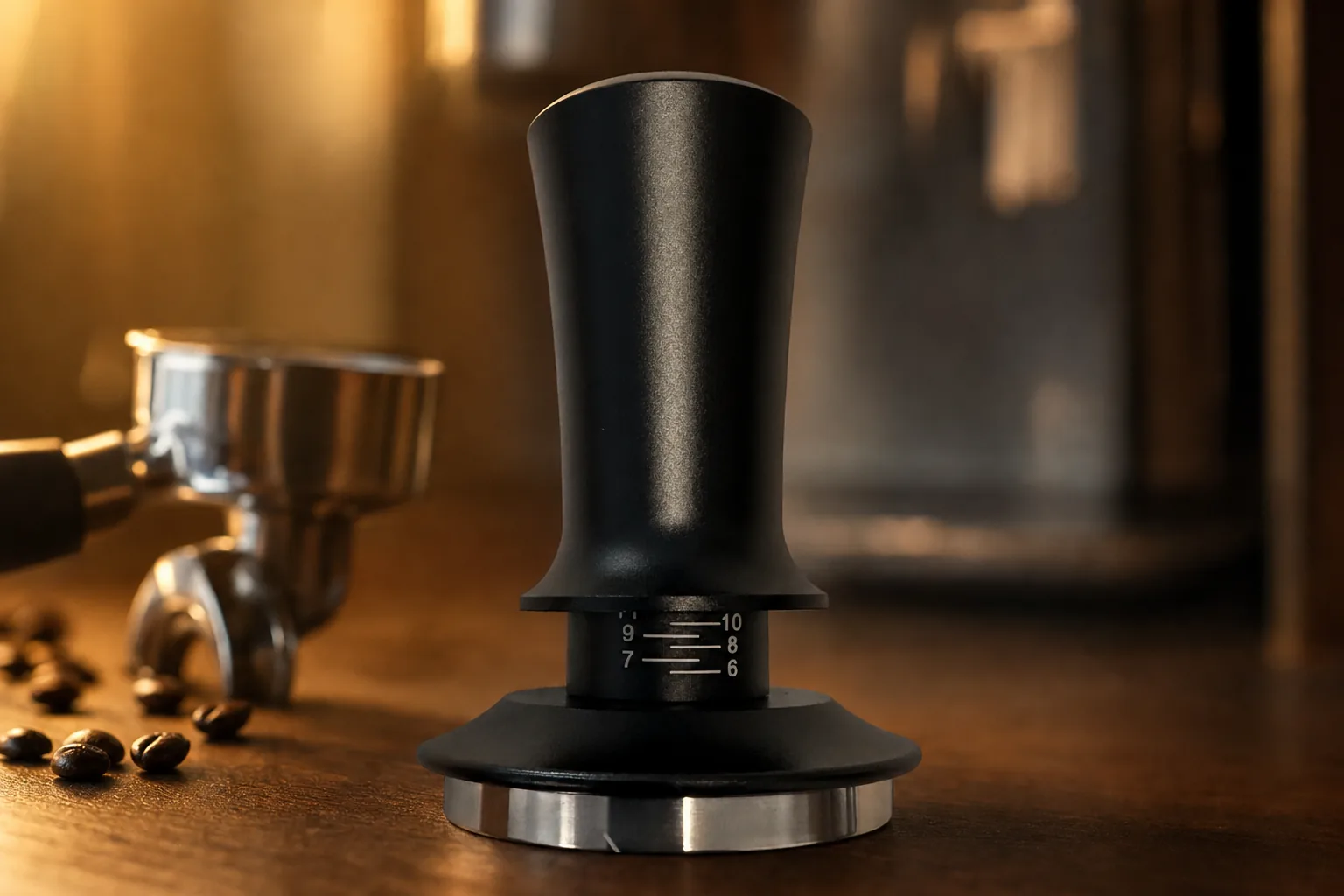
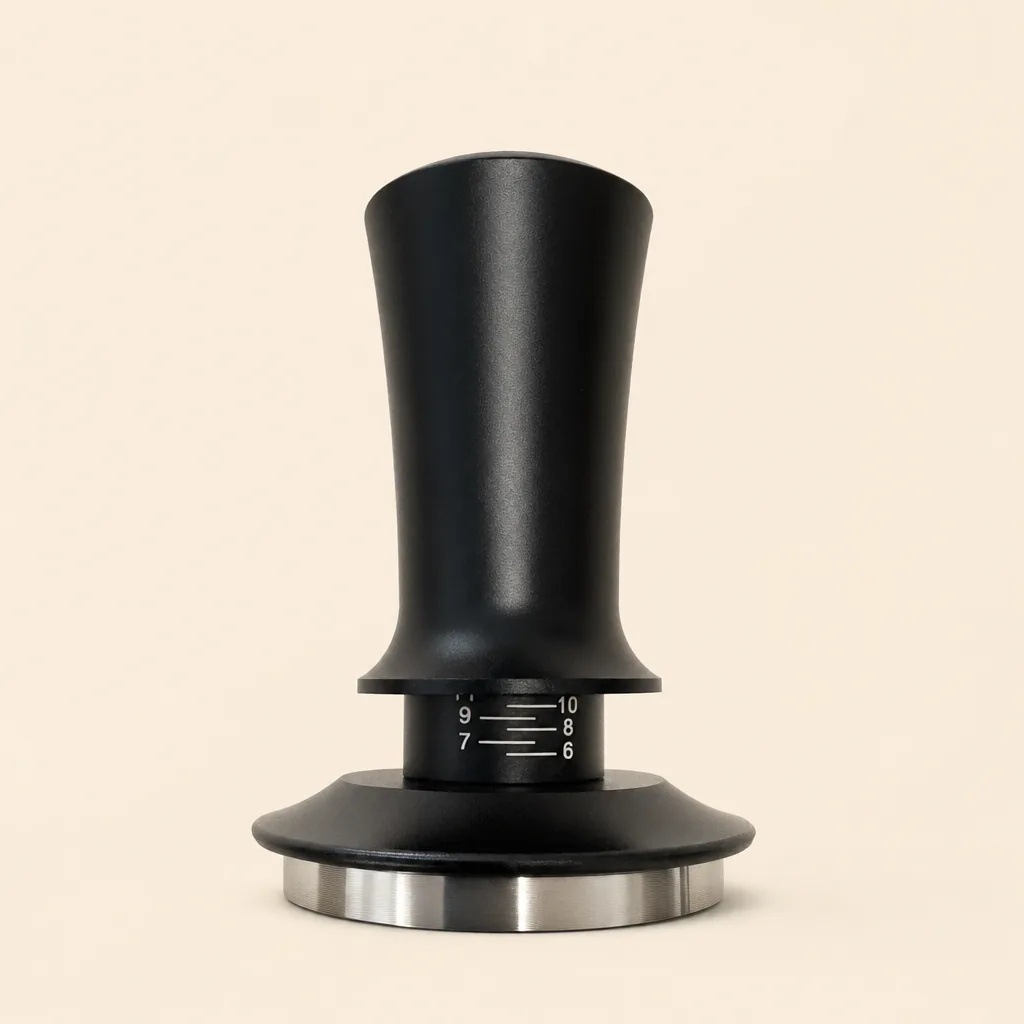
A knurled collar under the handle is marked from 6 to 14. Turning it sets how far the base travels into the basket, which is what you adjust when you change dose or move to a deeper basket.
This is the control people most often mistake for a pressure setting. It is not. The force stays at 15 lb whatever the collar reads. What changes is the depth at which the spring reaches its stop, so the tamper suits the basket you actually own.
Calibrated, flat, or palm tamper
| Calibrated spring | Flat hand tamper | Palm tamper | |
|---|---|---|---|
| Repeatable force | Yes, mechanical stop | No, depends on the arm | Partly, depends on the model |
| Leveling help | Base seats on the basket rim | None, you level by eye | Rests on the rim |
| Depth control | Collar marked 6 to 14 | None | Rarely |
| Learning curve | One shot | Weeks of practice | Short |
| Typical price | $29.90 – $49.99 | $8 – $15 | $40 – $70 |
The gap between these three shows up in the first months, while the hand is still learning what fifteen pounds feels like, and it keeps showing up on the mornings when it forgets. At $34.95 you get the stop, the ripple base and the graduated collar.
Every espresso variable you can automate is one you no longer have to feel your way through at six in the morning. Tamping is the easiest one to hand over to a spring, and it is the one people hand over last.— Nate Halloran, barista trainer, 11 years behind an espresso machine
Choosing and using a coffee tamper
How to choose the right one
Start with the basket, not the machine. The number that matters is the inside diameter of your portafilter basket. Take a ruler across the inside rim, ignore the portafilter body, and read the widest point. Delonghi and most compact machines land on 51mm. Breville and Sage machines, sold under both names depending on the country, land on 53 to 54mm. Full-size machines land on 58mm.
Aim for a close fit, not a loose one. A tamper noticeably smaller than the basket leaves a ring of untamped coffee around the edge, and water goes straight through that ring instead of the bed. This is the single most common cause of a fast, sour shot in a home setup. A tamper too large simply will not seat.
Then take the spring. A calibrated tamper gives you a stop you cannot talk yourself out of, which turns a technique you are still building into a result you can repeat today. If your shots vary and you cannot say why, that stop is the shortest route to steady espresso.
Handle shape is comfort only. Straight handles suit a palm-down push. Rounded bulb handles suit a wrapped grip. Neither changes what reaches the coffee. Pick the one your hand prefers, since you will use it several times a day.
Ignore the pressure arms race. The 30 lb figure repeated across forums comes from commercial bars with deeper baskets and heavier doses. At home, with 15 to 20 grams in a domestic basket, a consistent lighter tamp on a level bed produces a more even extraction than a heavy one applied at a slight angle.
Specifications
| Base material | 304 stainless steel, concentric ripple face |
|---|---|
| Handle material | Anodized aluminum, matte black |
| Tamping load | 15 lb, calibrated, not interchangeable |
| Depth adjustment | Graduated collar, marked 6 to 14 |
| Sizes | 51mm · 53/54mm · 58mm |
| Handle shapes | Straight (tapered) or rounded (bulb) |
| Color | Black |
| Common fitments | Delonghi 51mm · Breville and Sage 53/54mm · standard 58mm |
Setting it up the first time
Start at the middle of the range. Dose as you normally would, level the bed with a finger or a distribution tool, then press until the spring gives. Do not push past the give: once it has clicked, the load is delivered and anything further is your arm, not the tool. Lock in and pull the shot as usual.
Then read the puck rather than the collar. If the tamper sinks so far that the bed sits well below the rim, there is too little coffee under it for the depth you have set, and the shower screen will not meet the puck cleanly. Turn the collar down. If the tamper meets resistance almost immediately and the spring barely travels, the bed is too high for the setting, and you turn it up. One adjustment is usually enough, and it stays put until you change dose or basket.
Two habits matter more than the setting itself. Level the bed before you tamp, because a calibrated tamper delivers the same force to a sloped bed just as faithfully as to a flat one. And lift straight up rather than twisting. The ripple base is machined to release cleanly, but a twist on the way out still drags the surface. If you are working out which size you need before any of this, the tamper size guide covers the measurement.
Cleaning takes seconds. Wipe the base with a dry cloth after use so oils do not build up in the grooves. If they do, warm water and a soft brush clear them out. Keep the collar dry and do not put the tamper in a dishwasher: the detergent will dull the anodized handle and there is no reason to submerge a tool that only ever touches dry grounds.
More on the mechanism in our guide to calibrated tampers, on machine fitment in the Breville and Sage guide, and on terminology in espresso tampers explained.
Rated 4.9 / 5 across 460 verified ratings
"Easy to use, i can adjust to 10 since its the ideal for me to make espresso, and recommended as well."
Verified buyer · 51mm, straight handle
"Good quality stainless steel tamper. Function and style in one good product."
Verified buyer · 51mm, straight handle
"Works perfectly and very high quality. I can recommend it for the money. 51mm for Delonghi portafilter."
Verified buyer · 51mm, straight handle
The five questions buyers ask most
If you are new to tamping, these five guides cover the whole decision: what the tool does, how hard to press, which base to pick, whether you also need a distribution tool, and how to tamp so that every shot comes out the same.
What is a coffee tamper?
What the tool does to the coffee bed, and why an even press changes how the shot tastes.
How much pressure do you need?
Why the number matters less than repeating it, and where a calibrated spring fits in.
Ripple base or flat base?
What the concentric grooves change in the puck, and when a flat base is the better call.
Tamper or distribution tool?
They do two different jobs. Which one to buy first, and whether you need both.
How to tamp espresso
The four steps, in order, so the tamp stops being the variable in your morning shot.
Coffee tamper questions, answered
What size coffee tamper do I need?
Measure the inside of your portafilter basket, not the outside of the portafilter. Most Delonghi machines take 51mm, Breville and Sage take 53 to 54mm, and full-size machines take 58mm. Our size guide walks through the measurement in under a minute if you are unsure.
What does a calibrated tamper actually do?
A spring inside the handle compresses at a set load and stops there. Once you feel it give, you have applied the same force as last time. It removes the guesswork that makes two shots from the same beans taste different, which is the usual reason a home espresso is inconsistent.
Is the pressure adjustable?
No. The spring is calibrated to 15 lb and is not interchangeable. What you can adjust is the tamping depth, using the graduated collar marked 6 to 14. That sets how far the base travels into the basket, which matters when you change dose or basket depth.
Is 15 lb enough pressure?
For a home setup, yes. The often-repeated 30 lb figure comes from commercial bar work and heavier baskets. What changes a shot far more than raw force is applying the same force every time, on a level bed. A lighter, repeatable tamp beats a hard, uneven one.
What is a ripple base and does it matter?
The base is machined with fine concentric grooves rather than left flat. The pattern is intended to reduce the suction that pulls grounds up when you lift the tamper, which is what leaves a scuffed puck surface. In practice it means fewer divots to correct before you lock in.
Straight or rounded handle — which should I pick?
It is comfort, not performance. The straight handle is tapered and suits people who push from the palm. The rounded handle is a bulb shape and suits a wrap-around grip. Both carry the same base, the same spring and the same depth collar.
Will it fit a bottomless portafilter?
Yes, provided you match the basket size. A bottomless portafilter uses the same baskets as a standard one, so the sizing rule does not change. If you run a 58mm machine with a precision basket, the 58mm tamper is the one you want.
How long does delivery take and can I return it?
Orders are dispatched within 1 to 2 business days and arrive in 6 to 10 business days. Returns are open for 30 days and cost you nothing to send back. The full list of destinations is on the shipping page.
Can I put it in the dishwasher?
Better not to. Detergent dulls the anodized finish on the handle and there is nothing on a tamper that needs that kind of cleaning, since it only ever meets dry grounds. A dry cloth after each use is enough, and a soft brush under warm water when oils build up in the grooves.
Does it work alongside a distribution tool?
Yes, and the two do different jobs. A distributor levels the bed before you tamp; the tamper compresses it. Using a distributor first actually makes a calibrated tamper more effective, because a mechanical stop applied to a level bed is what produces an even extraction.
Which size fits a Breville Barista Express?
The Barista Express takes a 54mm basket, so the 53/54mm tamper is the one to order. The same machine is sold as a Sage Barista Express in the United Kingdom and takes the same size. Our machine fitment guide lists the common models.
Stop guessing at the tamp
Pick your basket size and handle shape. Free shipping, and 30 days to send it back if it is not for you.
Choose your size →