
Espresso tamper, calibrated to 15 lb
Two names, one tool. In the United States most people search for an espresso tamper; elsewhere the same object is usually called a coffee tamper. Retailers use both, sometimes on the same page, and nothing about the product changes between them. If you have been comparing results under the two terms and wondering what you were missing, the answer is nothing.
What the tamper actually changes
Espresso is water forced through a compressed bed of ground coffee at around nine bars. Water is lazy: given a choice between a dense route and a loose one, it takes the loose one every time. That is what channelling means, and it is why a shot can run pale and fast while the coffee at the edge of the basket is still barely touched.
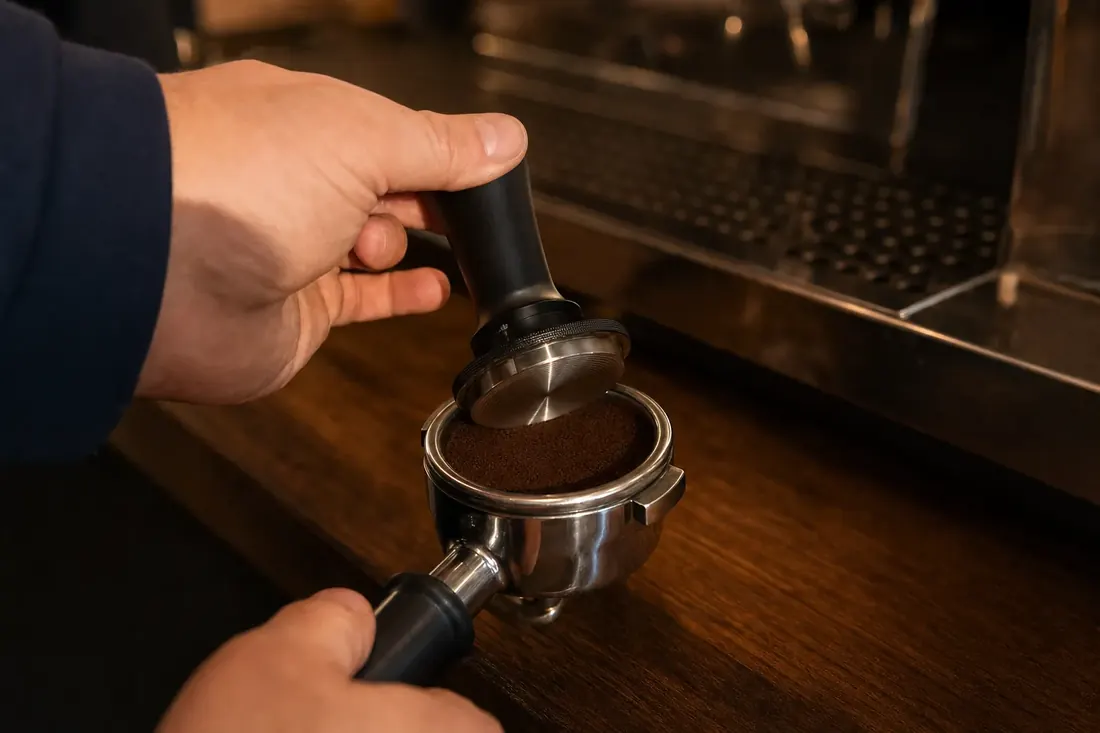
The tamper decides how uniform that bed is. Not how hard it is pressed, which matters far less than people assume, but how evenly. A bed pressed firmly on one side and lightly on the other has a built-in easy route, and no grind adjustment will close it. A bed pressed the same way every time gives you a baseline, and a baseline is what makes every other adjustment readable.
That is what this tool buys you: a bed you have made the same way twice. For most people running a home machine in the morning, the tamp is the variable that moves most, which is exactly why fixing it changes the most.
Calibrated, flat, or palm
| Calibrated | Flat | Palm | |
|---|---|---|---|
| Force applied | Fixed by a spring | Whatever your arm does | Fixed on some models |
| Helps level the bed | Seats on the basket rim | No | Rests on the rim |
| Depth setting | Collar marked 6 to 14 | None | Rarely |
| Time to get consistent | One shot | Weeks | Days |
| Typical price | $29.90 – $49.99 | $8 – $15 | $40 – $70 |
How ours is built
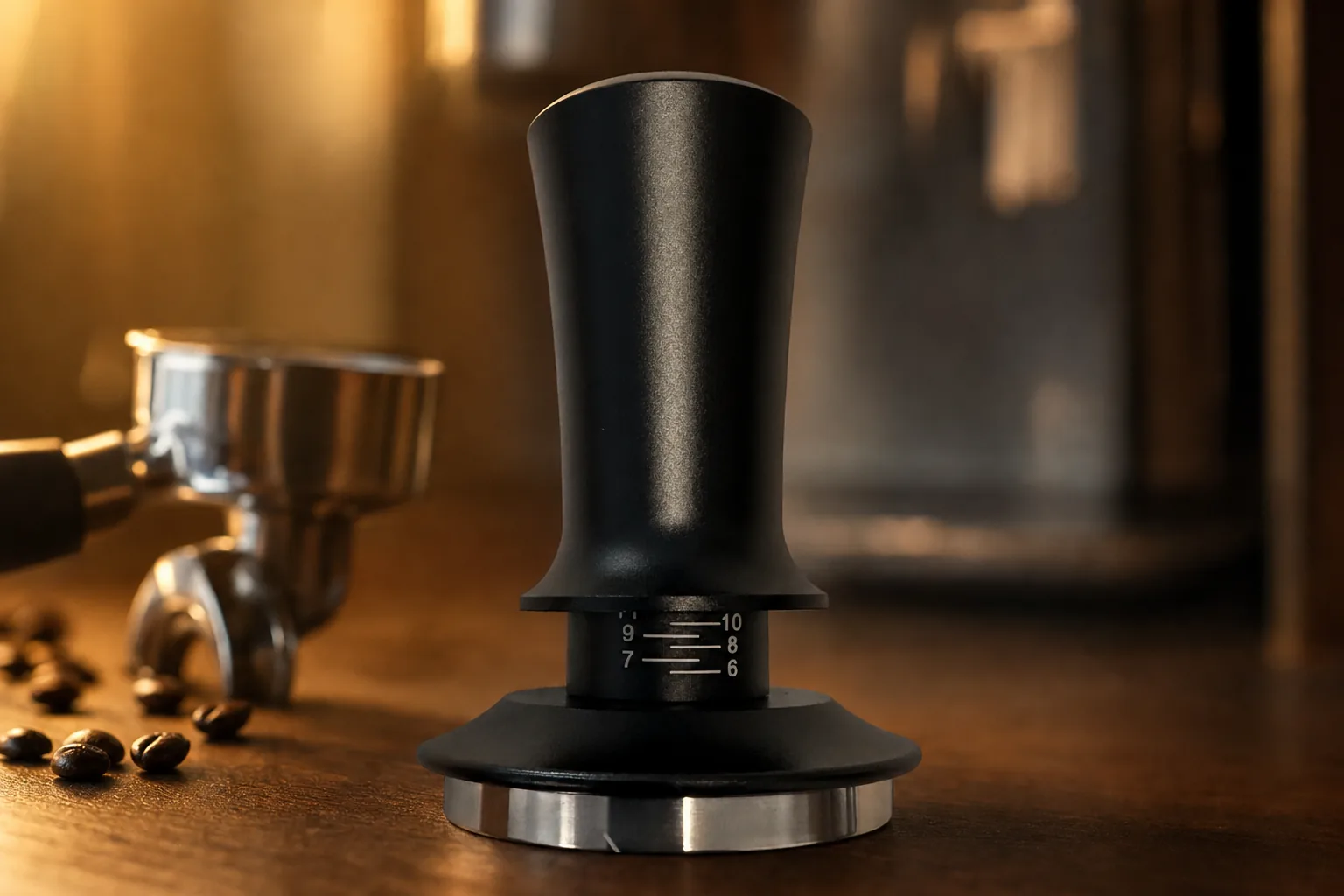
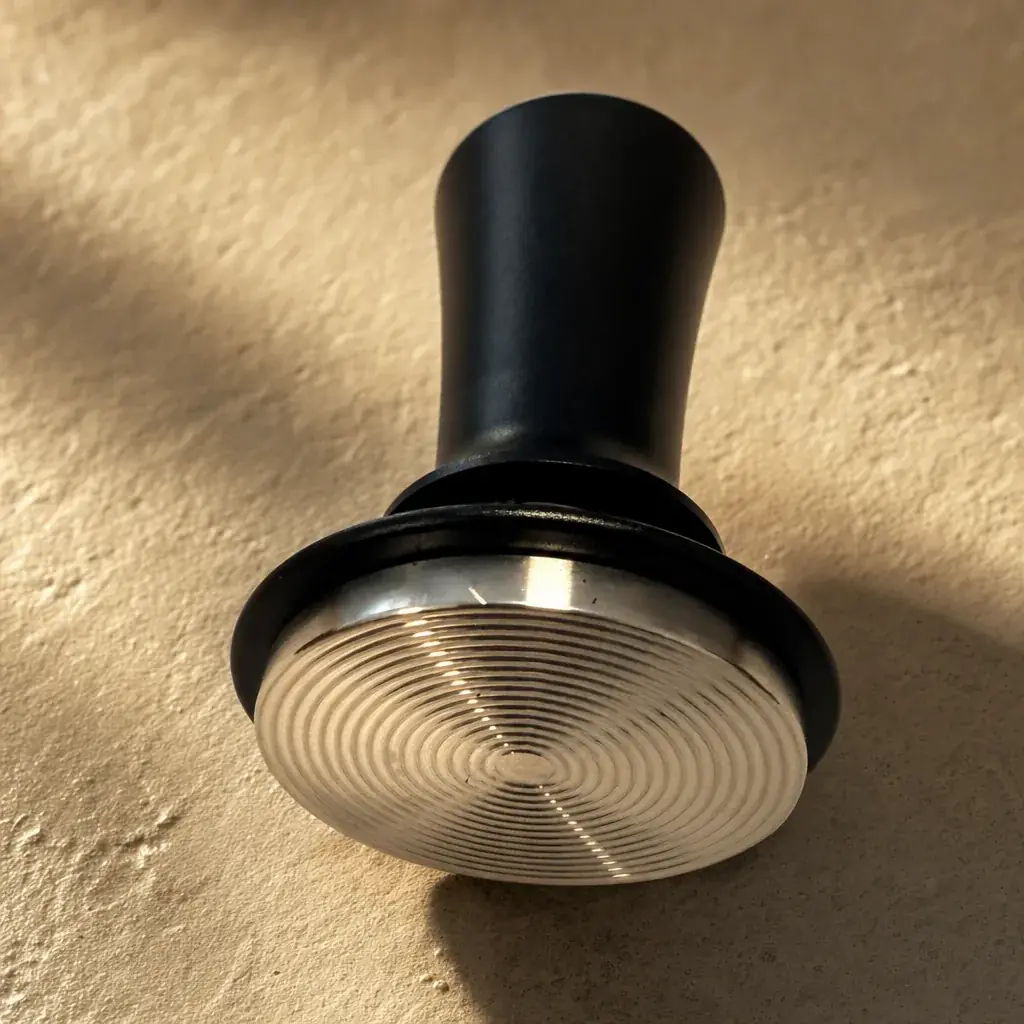
The base is 304 stainless, machined with fine concentric grooves rather than left flat. A flat face can behave like a piston on a damp bed and pull a divot out of the surface as you lift; the grooved face releases more cleanly. The handle is anodized aluminum, and under it sits a knurled collar marked 6 to 14 that sets how deep the base travels before the spring reaches its stop.
That collar is the part people most often misread. It does not change the force. The spring is calibrated to 15 lb and is not interchangeable, so whatever the collar reads, the load reaching the coffee is the same. What the collar adapts to is your dose and your basket depth. Set it once for how you make coffee, and it stays there until you change one of those two things. Our page on calibrated tampers goes through the mechanism in more detail.
Fifteen pounds is a home load rather than a commercial one. It is the load a domestic basket wants, it is comfortable to deliver at seven in the morning, and it arrives identically on every shot. That last part is the one that changes how your espresso tastes, and it comes at a price below the middle of the category.
Getting the size right
This is where most of the disappointment in this category comes from, and it is entirely avoidable. The number that matters is the inside diameter of your basket. A tamper 2mm too small leaves an untamped ring around the edge, and that ring is exactly the easy route water is looking for. A tamper too large will not seat at all.
| Basket size | Common machines |
|---|---|
| 51mm | Delonghi and most compact home machines |
| 53 / 54mm | Breville, sold as Sage in the United Kingdom |
| 58mm | Full-size and prosumer machines |
If you are not sure which you have, the size guide walks through the measurement, and the Breville and Sage guide lists the common models by name. Both take less time than returning the wrong tamper would.
Three things to get right alongside it
The tamp is one step in a short chain. Get these three right and the calibrated stop does the rest of the work for you.
An unlevelled bed. A calibrated tamper delivers its 15 lb just as faithfully to a sloped bed as to a flat one. If your dose lands in a mound on one side of the basket, pressing it evenly still leaves it deeper on that side. Level the grounds with a finger or a distribution tool first; the tamp is the second step, not the first.
A grind that is wrong for the basket. If the shot gushes in twelve seconds, the grind is too coarse and no amount of pressure will hold the water back. Tamping harder to compensate is the single most common wrong turn in home espresso, and it produces a bitter shot rather than a slow one. Fix the grind, then let the tamper hold your baseline steady while you do it.
A twist on the way out. Old advice recommends a polishing twist at the end of the tamp. On a grooved base it drags the surface it just made. Press until the spring gives, then lift straight up. That is the whole motion.
What buyers report
The tamper holds 4.9 out of 5 across 460 verified ratings, with the 51mm the most represented size among photographed reviews. The full set, with photographs, is on the reviews page.
Espresso tamper questions
Is an espresso tamper different from a coffee tamper?
No. They are two names for the same tool, and you will see both used by the same retailers. Espresso tamper is the more common phrasing in the United States, coffee tamper elsewhere. Neither indicates a different product, a different size range or a different mechanism.
What size espresso tamper do I need?
Match the inside diameter of your basket, not the outside of the portafilter. Delonghi and most compact machines take 51mm, Breville and Sage take 53 to 54mm, and full-size machines take 58mm. Measuring across the inside rim with a ruler takes about a minute.
Do I need a calibrated one, or will a flat tamper do?
Take the calibrated one. It stops at a fixed load, so the bed is pressed identically whether it is your first coffee or your fourth, and you stop wondering whether the tamp was the thing that changed. That matters most while your technique is still forming, and it keeps paying afterwards.
Does a heavier tamp make better espresso?
Past a point, no. Consistency and a level bed matter more than force. The 30 lb figure that circulates online comes from commercial bar work with deeper baskets. At home, a repeatable 15 lb on a flat bed extracts more evenly than a hard tamp applied at a slight angle.
More reading: how to tamp espresso · how much pressure you need · ripple base vs flat base · back to the coffee tamper