
· Nate Halloran
Ripple base vs flat base
This is one of the few genuine differences between tampers that are otherwise identical, and it is also one of the most oversold. What follows is what the grooves actually do, what they do not do, and how the two compare across the setups people actually run.
The problem the grooves address
Ground coffee holds a little moisture, especially if you spritz the beans before grinding. Press a smooth steel disc onto a slightly damp bed and you create a seal, in the same way a wet glass sticks to a countertop. Lift it and the seal resists, then breaks unevenly, and it can take a small amount of the surface with it.
What you are left with is a shallow divot or a scuffed patch. On its own it is minor, and you can smooth it over with the base before locking in. Repeated every morning, it is one more small inconsistency in the step you were trying to make consistent.
Concentric grooves interrupt that seal. Air reaches the interface sooner as you lift, so the base separates progressively rather than all at once. The bed you leave is the bed you made.
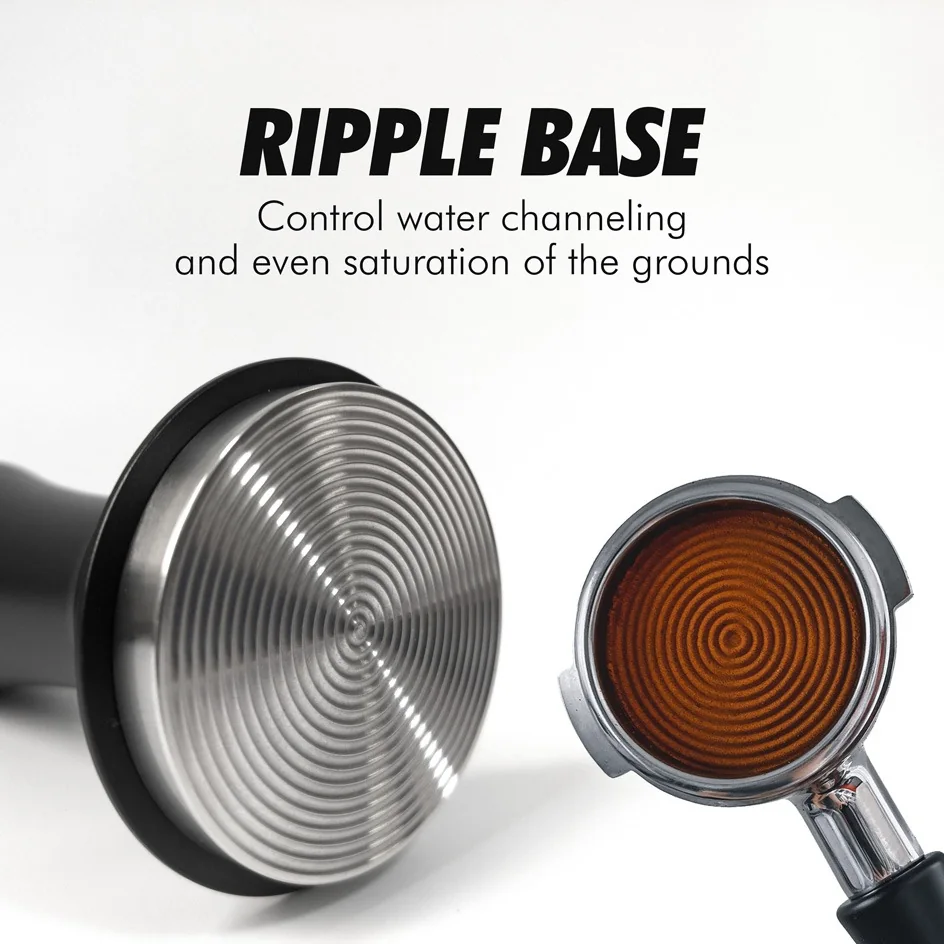
What it does not do
Two claims circulate that go further than the evidence.
That the grooves change how water flows. The pattern they impress is a few tenths of a millimeter deep on a bed that is several millimeters thick, and the first moments of the shot flatten it. Whatever benefit exists comes from a cleaner release, not from steering water once the shot starts.
That it prevents channelling. Channelling comes from an uneven bed, an undersized tamper, or a grind badly out of range. A ripple base does not correct any of those. It avoids adding a defect of its own, which is a smaller and more honest claim.
Which base suits which setup
| Situation | Better choice | Why |
|---|---|---|
| You spritz beans or work in humid conditions | Ripple | The damper the bed, the stronger the seal |
| You use a distribution tool first | Either | The bed is already even; release matters less |
| You want the simplest thing to clean | Flat | No grooves for oils to sit in |
| You are replacing an undersized tamper | Whichever fits | Diameter outranks base pattern every time |
That last row is the short version of this whole comparison. A flat base in the right diameter beats a ripple base in the wrong one, comfortably. If you are choosing between tampers and one of them does not match your basket, the base pattern is not the deciding factor. The size guide settles that question first.
Cleaning a grooved base
The one practical trade-off. Coffee oils collect in the grooves over weeks, and left alone they go rancid, which taints a shot faintly and is annoying to trace. A dry cloth after each use handles it. Once in a while, warm water and a soft brush across the grooves clear what the cloth misses.
Avoid the dishwasher, on this or any tamper with a spring: detergent dulls an anodized handle and there is no reason to submerge a tool that only meets dry coffee. The full routine, including what to do when a cloth stops being enough, is in how to clean a coffee tamper.
How to tell them apart in a listing
Photographs in this category are often taken from above, where every tamper looks the same. Two things settle it. The first is the wording: ripple, rippled and concentric all describe the same grooved face, while flat, plain and polished describe a smooth one. The second is the reflection. A smooth base throws back a single clean highlight; a grooved one breaks that highlight into a series of fine rings, which is visible even in a small thumbnail once you know to look for it.
Be a little careful with the word textured. Some makers use it for a grooved face and some for a bead-blasted matte finish, which is a different thing entirely and behaves like a flat base. If the listing does not show the underside clearly, that is worth more hesitation than any claim in the description.
Does it change how the puck looks?
Yes, and it is the most common question we get about it. A ripple base leaves faint concentric rings pressed into the surface of the bed, which look deliberate and rather satisfying. They are also gone within the first second of the shot, as soon as water hits the puck and the surface saturates.
This is worth saying plainly because the rings photograph well and get used as evidence that the base is doing something to the extraction. What they show is that the base has released cleanly, which is the actual benefit. The pattern itself is not doing work once the water arrives.
If your puck comes out with a divot in it rather than rings, that is the suction problem this whole article describes, and it is one of the few tamper faults you can diagnose by looking. A cleanly released bed sits flat and even across its whole surface, whichever base made it.
Convex bases, briefly
The third option you will meet. A convex base curves slightly downward at the center, on the theory that it drives grounds outward toward the basket wall, where channelling most often starts. Opinions on it are genuinely divided, and it interacts with basket shape in a way that makes blanket advice unreliable.
For a home setup, flat or grooved is the straightforward choice, and the difference between those two is the one described above. The tamper we make uses a 304 stainless ripple base in all three sizes, which is covered on the calibrated tamper page along with the spring and the depth collar.
Where to go next
If you are choosing a tamper rather than reading about bases, start with the diameter, because it is the only specification that can make a tamper unusable. Once that is settled, the base pattern is a preference rather than a decision, and either answer will serve you well for years.
Related reading: how to tamp espresso · how much pressure you need · what a coffee tamper is · tamper vs distribution tool · how to clean a coffee tamper · coffee tamper substitutes · choosing the best coffee tamper · tamping and wrist pain
On the product: the calibrated coffee tamper · which size fits your machine · Breville and Sage fitment · what buyers report